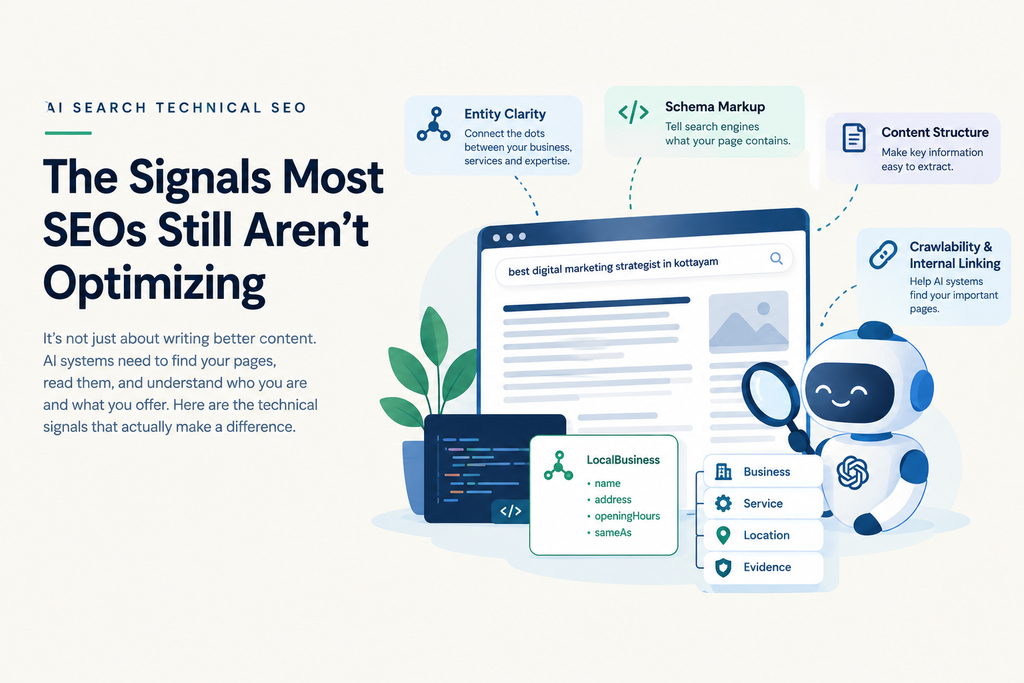
Most advice on AI search technical SEO starts and ends with “write better content.” That’s fine, but it skips the plumbing. AI systems still have to find your pages, read them, and work out who you are and what you offer. If that part is messy, great writing won’t save you.
I’ve seen this on real sites. The content was decent, but search engines and AI systems couldn’t connect the dots. In this post, I’ll show you the technical signals that get overlooked and the fixes that helped.
What Makes AI Search Technical SEO Different?
Classic SEO asks, “Does this page match the keyword?” AI-driven search asks a bigger question: “Can I pull a clear answer from this page and trust it?”
That shift puts more weight on three things:
- Clarity: Can a machine tell what each page is about?
- Structure: Is the key information easy to extract?
- Connections: Is it obvious how your brand, services, and expertise relate?
One honest caveat. According to Google’s guidance on AI features, you don’t need special markup to appear in AI Overviews. The same foundations of good SEO apply. So no trick exists here. The win comes from doing the basics more clearly than your competitors do.
The Technical Signals Most SEOs Still Aren’t Optimizing
1. Entity clarity
An entity is a distinct thing: a company, a service, a person, a place. AI systems build understanding by linking entities together.
Many sites never spell this out. The services page mentions “SEO,” the about page mentions “experts,” and nothing ties them to each other. A human can guess the link. A machine often can’t.
2. Schema that matches the page
Structured data (schema markup) tells search engines what a page contains in a format they can read easily. It works best when it mirrors what visitors actually see. More on that in the mistakes section below.
3. Content structure that’s easy to extract
Headings, short paragraphs, and direct answers make life easier for AI systems. When I audit a page, I check whether the main point appears near the top of each section. If a reader has to hunt for it, a machine probably will too.
4. Crawlability and internal linking
This one sounds basic, but it’s still skipped. If important pages aren’t indexable or don’t have internal links, AI systems may never reach them. Our technical SEO audit checklist covers the quick checks.
A Real Example: A Digital Marketing Services Site
Here’s a project that shows how these signals work together.
The problem: The site sold digital marketing services, but its services and expertise weren’t clearly linked to specific entities or structured data. Search engines saw pages. They didn’t see a business with defined services.
What I changed:
- Improved the content hierarchy so each service had a clear place in the site structure
- Tightened the page structure and keyword targeting
- Added Organization, LocalBusiness, and Service schema
What happened: The site became easier for search engines to understand. Visibility improved, more relevant impressions came in, and richer information started appearing in results.
[Add your real numbers here, such as the impressions change and the timeframe.]
I should be upfront about a limit. I changed several things at once, so I can’t credit schema alone. That’s normal in real client work, and it’s why I’d treat any single-factor claim in this space with caution.
Want a second pair of eyes on your schema? [CTA: Book a free technical audit]
Which Schema Types Should You Start With?
You don’t need every type. Start with the ones that describe your business clearly.
| Schema type | What it tells search engines | Best used on |
| Organization | Who you are, your logo, and your official profiles | Home page, about page |
| LocalBusiness | Your location, hours, and contact details | Contact page, location pages |
| Service | What you offer and who it’s for | Individual service pages |
You can find the full property lists on Schema.org/Local Business. For a deeper walkthrough, see our schema markup guide.
The Most Common Schema Mistake
The biggest mistake I see is adding a schema that doesn’t match the page. Someone copies a template, pastes it in, and moves on. The markup claims details the visible content never mentions.
This causes trouble. Google’s structured data guidelines say markup should reflect what users can see on the page. Mismatched markup can also confuse the very systems you’re trying to help.
Here’s what I tell people to do instead:
- Use only schema types that fit the page.
- Make sure every marked-up detail also appears in the visible content.
- Keep headings logical and answers concise.
- Name your entities consistently across the site.
Three Things to Do This Week
If you only have a few hours, start here:
- Add relevant schema markup. Begin with Organization, LocalBusiness, and Service, and match each one to its page.
- Improve your content structure. Use clear headings, concise answers, and well-defined entities.
- Audit crawlability. Confirm that your important pages are indexable, internally linked, and technically accessible.
Do them in that order if your site has no schema yet. If it does, start with the audit, because broken foundations undo everything else.
Need help prioritizing? [CTA: Download our AI search readiness checklist]
FAQs
Do I need schema markup to appear in AI search results?
No. Google says no special markup is required for its AI features. Schema still helps search engines understand your content, so it’s worth doing well.
What’s the best schema type for a service business?
Start with Organization, LocalBusiness, and Service. Together, they describe who you are, where you work, and what you sell.
Can wrong schema hurt my site?
It can. Markup that doesn’t match the visible page breaks Google’s guidelines and can create confusion. Fewer, accurate types beat many inaccurate ones.
How long does it take to see results?
It varies by site size, crawl frequency, and competition. In my experience, improvements show up gradually, not overnight, and other changes often contribute too.
Conclusion
AI search technical SEO isn’t about chasing a secret ranking signal. It’s about making your site easy to read, easy to trust, and easy to connect to the right entities.
Start with matched schema, clean content structure, and a crawlability check. Then keep improving. Small technical fixes tend to compound, and most of your competitors are still ignoring them.
Looking for the best digital marketing strategist in Kottayam to grow your brand online? I help businesses build a stronger digital presence through strategic SEO, social media marketing, Google Ads, online advertising, and conversion-focused digital marketing strategies. My approach combines creative brand communication with data-driven marketing to attract the right audience, increase visibility, and turn online attention into meaningful business growth. Whether you are a local business, startup, or established brand, I create practical digital strategies tailored to your goals, audience, and market.