Google EEA local business search results just changed. Google logged an update on September 18 saying its two EEA result units now support local business queries, and it revised the Search Central pages for both units the same day. Search Engine Journal
My first reaction was that this could be a major shift for local SEO. Rankings still matter. But now the way your business data is read matters just as much.
Here’s what changed, who it affects, and what I’d do this week.
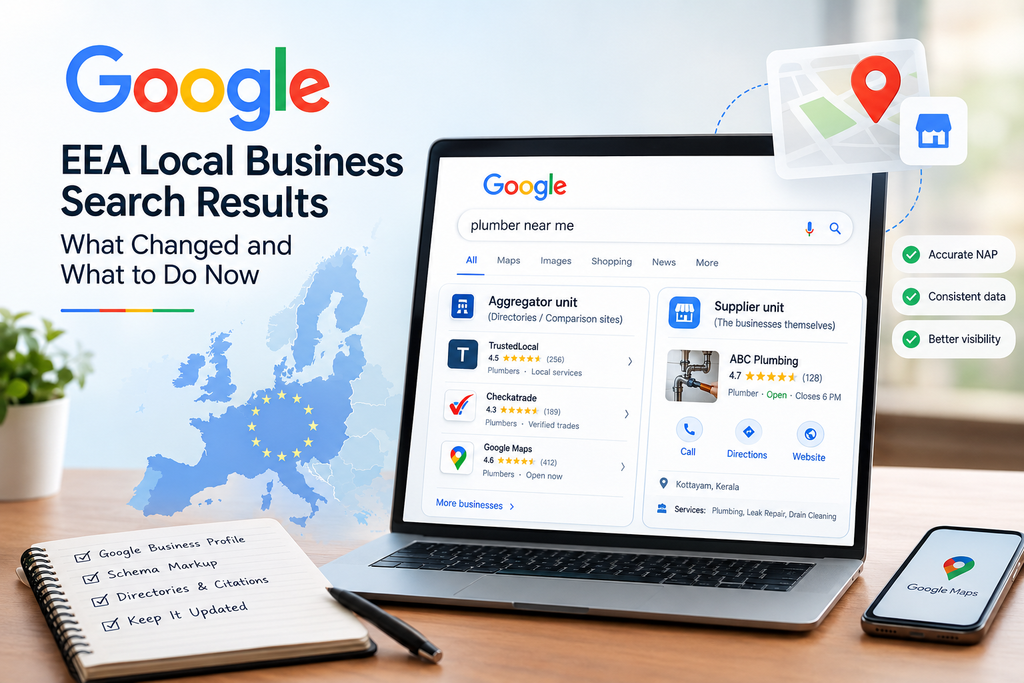
What Changed in Google EEA Local Business Search Results?
Google’s redesigned results in the European Economic Area (EEA) use two units: an aggregator unit and a supplier unit. Before this update, the documentation focused on hotels, flights, trains, buses, and products. Both pages now list local businesses as well. Search Engine Journal
Google’s changelog gives a one-line explanation, and the updated pages also point to a Local Point of Interest Feed page for local business queries. Search Engine Roundtable
One limit before we go further. Google’s documentation describes these units for users in the EEA. I haven’t found any announcement that the local business change applies elsewhere.
How the Two Units Differ
| Aggregator unit | Supplier unit | |
| Who appears | Approved directories, comparison sites, and metasearch engines | The businesses themselves |
| Data needed | A data feed from the aggregator | Nothing beyond what Google can crawl |
| What it means for you | Your directory listings must be accurate | Your website and profile must be clear |
Let me explain each unit in plain terms.
The aggregator unit is built for vertical search services, including directories, and for local business queries it’s populated through direct data feed integrations. Only one aggregator unit shows at a time, and the top-ranked provider’s results are expanded by default. Google Search Engine Journal
The supplier unit is for direct providers, such as brick-and-mortar owners and service providers like plumbers. Your website must serve EEA users, and you don’t need to send extra data beyond what Google can crawl. Data feeds can enhance your results if you have them. Google
You can read both pages yourself: Google’s aggregator unit documentation and supplier unit documentation.
Why This Matters for Local SEO in Europe
Think of it as two doors into visibility. A searcher might see your business through a directory in the aggregator unit. They might also see it directly in the supplier unit.
Both paths depend on your data being right. If a directory shows an old phone number, that could be the version a searcher sees first. That’s my interpretation, not something Google has stated.
I also believe machines, including AI-driven features, increasingly read business data instead of just ranking pages. Google’s documentation doesn’t call these units AI, so treat that part as my opinion.
Want a second opinion on your local data? [CTA: Book a free local SEO audit]
The Audit I Run First
For a local service business, I start with the basics: the Google Business Profile, location details, services, reviews, and website schema. All of them need to be accurate and consistent. Here’s the order I follow.
- Audit your details. Check the business name, address, phone number (NAP), and services on every platform.
- Fix your own properties first. Clean up the website and Google Business Profile before anything else.
- Add or validate schema. Use LocalBusiness and Service markup, and make sure it matches the visible page.
- Check citations and directories. Hunt for outdated listings, since directories may feed the aggregator unit.
- Monitor and update. Change your details everywhere whenever the business changes.
[Add a real example from your own work here, such as a client whose details were inconsistent and what changed after the fix.]
For a deeper walkthrough, see our local SEO audit checklist.
The Most Common Mistake: Inconsistent Business Information
The mistake I see most is inconsistent business information, especially the name, address, phone number, and services. The website says one thing. The Google Business Profile says another. A directory says a third.
Small differences add up. Here are a few examples:
- “Ltd” on one platform and “Limited” on another
- A suite number missing from the website
- An old phone number left on a directory
- A service called something different on every page
Search engines then find it harder to identify the business with confidence. That can lead to less accurate local results.
The fix is boring but effective. Pick one correct version of every detail and copy it everywhere.
Does Schema Markup Matter Here?
Schema helps, but let’s be honest about how much. Google’s documentation says the supplier unit needs no extra data beyond what’s crawlable. It doesn’t say schema is required or a ranking factor for these units.
So why add it? Clean LocalBusiness and Service markup makes your data clear and machine-readable. It costs little, and it supports the same consistency work you’re already doing. Just keep it matched to what visitors see on the page. Our schema markup guide shows how.
Will This Expand Beyond the EEA?
It could. Google often tests features in one region first. But Google hasn’t announced that this local business unit will expand globally, so I wouldn’t plan around a rollout date.
The good news is that the prep work isn’t wasted. Accurate, consistent data helps you in regular local search everywhere.
What Local Businesses Should Do This Week
- Audit your Google Business Profile for accuracy.
- Keep NAP and service information identical across your site and listings.
- Implement relevant LocalBusiness and Service schema.
- Review the top directories that list you.
- Check Google’s documentation again soon, since this update is brand new and details may change.
FAQs
Do I need to apply to appear in the supplier unit?
Not for extra data. Google’s documentation says the supplier unit doesn’t require anything beyond what’s crawlable, but your site must serve EEA users. Google decides what appears.
Can a directory show up instead of my business?
Yes, possibly. Directories can appear in the aggregator unit if they’re approved and provide data. That’s why checking your directory listings matters.
Does this affect businesses outside Europe?
Google’s documentation describes the units for EEA users. I haven’t seen an announcement that the local change applies elsewhere.
Is schema markup required?
No. Google doesn’t list it as a requirement for these units. It still helps make your business details clear.
Conclusion
The update to Google EEA local business search results rewards businesses with clean, consistent data. You can’t control how Google designs the page. You can control whether your information is accurate everywhere it appears.
Start with your Google Business Profile, fix any NAP inconsistencies, add matching schema, and clean up your directory listings. Then keep it all current. It’s simple work, and most of your competitors will put it off.
Looking for the best digital marketing strategist in Kottayam to grow your brand online? I help businesses build a stronger digital presence through strategic SEO, social media marketing, Google Ads, online advertising, and conversion-focused digital marketing strategies. My approach combines creative brand communication with data-driven marketing to attract the right audience, increase visibility, and turn online attention into meaningful business growth. Whether you are a local business, startup, or established brand, I create practical digital strategies tailored to your goals, audience, and market.